Speech Genres and Other Late Essays by M. M. Bakhtin
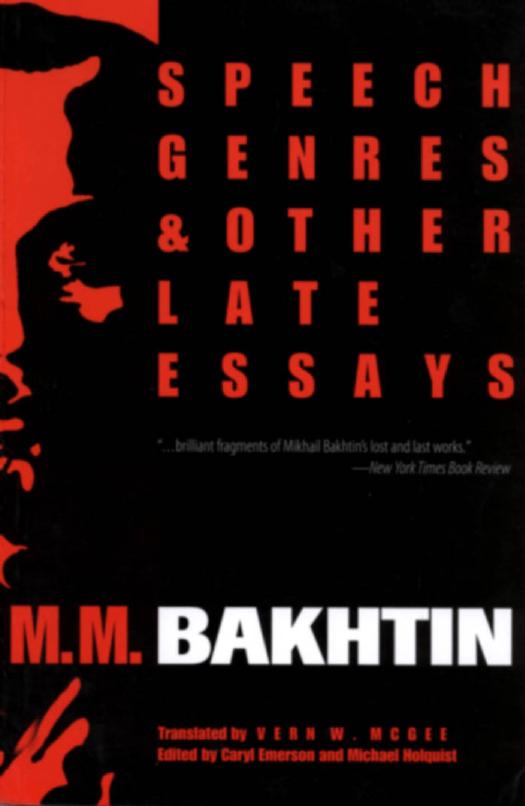
Author:M. M. Bakhtin
Language: eng
Format: epub, pdf
Publisher: University of Texas Press
Published: 1986-01-15T00:00:00+00:00
Notes
1. âNational unity of languageâ is a shorthand way of referring to the assemblage of linguistic and translinguistic practices common to a given region. It is, then, a good example of what Bakhtin means by an open unity. See also Otto Jesperson, Mankind, Nation, and Individual (Bloomington: Indiana University Press, 1964).
2. Saussureâs teaching is based on a distinction between language (la langue)âa system of interconnected signs and forms that normatively determine each individual speech act and are the special object of linguisticsâand speech (la parole)âindividual instances of language use. Bakhtin discusses Saussureâs teachings in Marxism and the Philosophy of Language as one of the two main trends in linguistic thought (the trend of âabstract objectivismâ) that he uses to shape his own theory of the utterance. See V. N. Voloshinov, Marxism and the Philosophy of Language, tr. Ladislav Matejka and I. R. Titunik (New York: Seminar Press, 1973), esp. pp. 58â61.
âBehavioristsâ here refers to the school of psychology introduced by the Harvard physiologist J. B. Watson in 1913. It seeks to explain animal and human behavior entirely in terms of observable and measurable responses to external stimuli. Watson, in his insistence that behavior is a physiological reaction to environmental stimuli, denied the value of introspection and of the concept of consciousness. He saw mental processes as bodily movements, even when unperceived, so that thinking in his view is subvocal speech. There is a strong connection as well between the behaviorist school of psychology and the school of American descriptive linguistics, which is what Bakhtin is referring to here. The so-called de-scriptivist school was founded by the eminent anthropologist Franz Boas (1858â1942). Its closeness to behaviorism consists in its insistence on careful observation unconditioned by presuppositions or categories taken from traditional language structure. Leonard Bloomfield (1887â1949) was the chief spokesman for the school and was explicit about his commitment to a âmechanist approachâ (his term for the behaviorist school of psychology): âMechanists demand that the facts be presented without any assumption of such auxiliary factors [as a version of the mind]. I have tried to meet this demand⦠.â (Language [New York: Holt, Rinehart, and Winston, 1933], p. vii). Two prominent linguists sometimes associated with the descriptivists, Edward Sapir (1884â1939) and his pupil Benjamin Lee Whorf (1897â1941), differ from Bloomfield insofar as behaviorism plays a relatively minor role in their work.
âVossleriansâ refers to the movement named after the German philologist Karl Vossler (1872â1949), whose adherents included Leo Spitzer (1887â1960). For Vosslerians, the reality of language is the continuously creative, constructive activity that is prosecuted through speech acts; the creativity of language is likened to artistic creativity, and stylistics becomes the leading discipline. Style takes precedence over grammar, and the standpoint of the speaker takes precedence over that of the listener. In a number of aspects, Bakhtin is close to the Vosslerians, but differs in his understanding of the utterance as the concrete reality of language life. Bakhtin does not, like the Vosslerians, conceive the utterance to be an individual speech act;
Download
Speech Genres and Other Late Essays by M. M. Bakhtin.pdf
This site does not store any files on its server. We only index and link to content provided by other sites. Please contact the content providers to delete copyright contents if any and email us, we'll remove relevant links or contents immediately.
4 3 2 1: A Novel by Paul Auster(12405)
The handmaid's tale by Margaret Atwood(7773)
Giovanni's Room by James Baldwin(7354)
Big Magic: Creative Living Beyond Fear by Elizabeth Gilbert(5780)
Asking the Right Questions: A Guide to Critical Thinking by M. Neil Browne & Stuart M. Keeley(5779)
Ego Is the Enemy by Ryan Holiday(5455)
The Body: A Guide for Occupants by Bill Bryson(5103)
On Writing A Memoir of the Craft by Stephen King(4948)
Ken Follett - World without end by Ken Follett(4740)
Adulting by Kelly Williams Brown(4582)
Bluets by Maggie Nelson(4563)
Eat That Frog! by Brian Tracy(4546)
Guilty Pleasures by Laurell K Hamilton(4454)
The Poetry of Pablo Neruda by Pablo Neruda(4113)
Alive: The Story of the Andes Survivors by Piers Paul Read(4037)
White Noise - A Novel by Don DeLillo(4018)
Fingerprints of the Gods by Graham Hancock(4009)
The Book of Joy by Dalai Lama(3996)
The Bookshop by Penelope Fitzgerald(3857)
